Hail to the King ~ Juno, Jupiter and origins of the Solar System

James
Next month NASA's new Jupiter mission will launch on its 6-year cruise and 1-year orbital mission to the gas giant and undoubted King of the Solar System, Jupiter. Jupiter, apart from some basic information, remains a bit of a mystery. At 143,000km in diameter it could swallow 1300 Earths and it contains two and a half times as much mass as all the other planets in the Solar System combined.
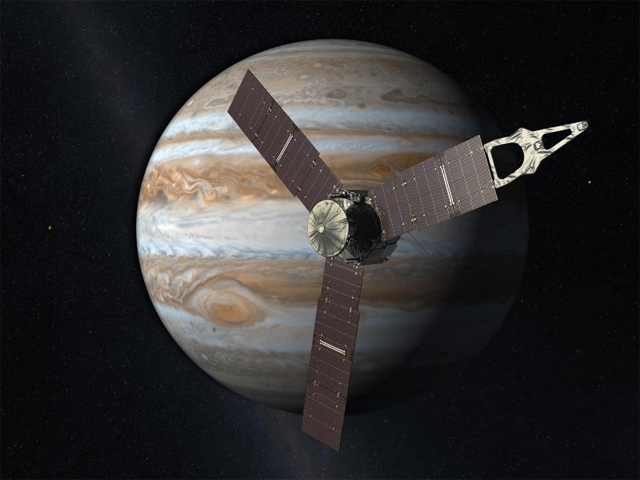
I love Jupiter, it's a great planet to observe and photograph, it often looks majestic just hanging there, as if by magic in the blackness surrounded by its obedient and loyal moons.
Jupiter is returning to our night skies in the northern hemisphere at the moment and by early August it will be rising 4 or 5 hours before sunrise, providing some good observing for a few hours before the sky starts to brighten. It will reach opposition during the dark winter nights on Saturday October 29th 2011 at 01:29:24 GMT. I plan to spend some time observing and photographing it, as this should be a great time to view Jupiter.
Juno is the next in NASA's New Frontiers program that has already sent New Horizons out towards Pluto and the Kuiper Belt. The mission has a $700 million budget and a number of clever cost-saving measures have been employed.
The Juno spacecraft will arrive at Jupiter in 2016 after its launch (currently planned for the 5th August 2011) to study Jupiter from a highly elliptical, polar orbit. Juno will repeatedly dive between the planet and its intense belts of charged particle radiation, coming within 5,000km from the cloud tops at closest approaches at the poles, swinging much further out at the equator.
The close approaches should return some spectacular photographs, although there is some doubt as to just how long the sensitive electronics of the camera will last in that radiation environment. The cameras are fixed to the body of the spacecraft and will only point towards Jupiter when the slow rotation of the spacecraft allows it - this is one of the cost-saving measures employed.
Juno's primary goal is to improve our understanding of Jupiter's formation and evolution. The spacecraft will spend a year investigating the planet's origins, interior structure, deep atmosphere and magnetosphere.
Juno's study of Jupiter will help us to understand the history of our own solar system and provide new insight into how planetary systems form and develop. It is believed that Jupiter formed as it collected material from the Solar protoplanetary disc during and continuing after the formation of our Sun, so new insights into its composition will vastly improve our understanding of this timeline.
Fundamental questions that Juno will address are:
- Does Jupiter have a solid core?
- If so, how big is it?
- Did this core form first and then the thick dense atmosphere?
- Did the huge ball of gas form first and simply grow so large that gas in its centre solidified under the pressure?
- Why do its equatorial belts rotate in opposite directions?
- What is driving the Great Red Spot?
- How much water does Jupiter contain?
- Why do we see so many Jupiter-sized exoplanets much closer to their parent stars than Jupiter itself?
To receive the answers to some of these questions will be amazing.
Good luck Juno!
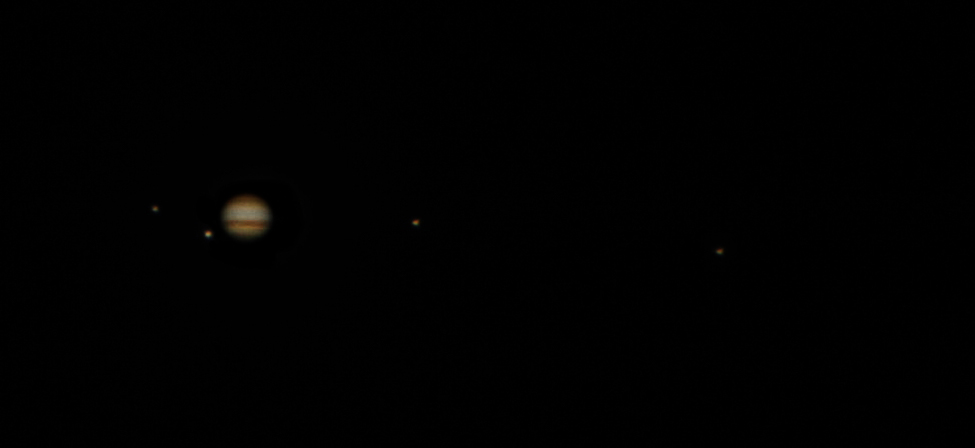
Turn your scopes to Jupiter in the coming months!
Similar Posts

May 31, 2020
• 1 min read

May 23, 2025
• 2 min read